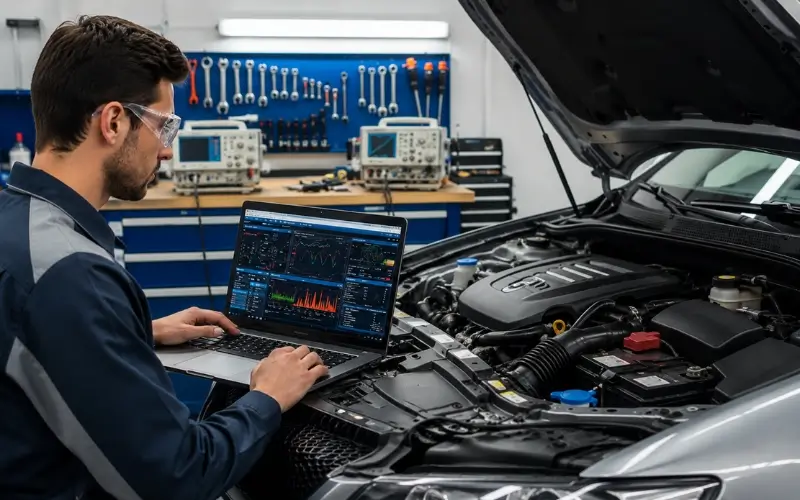
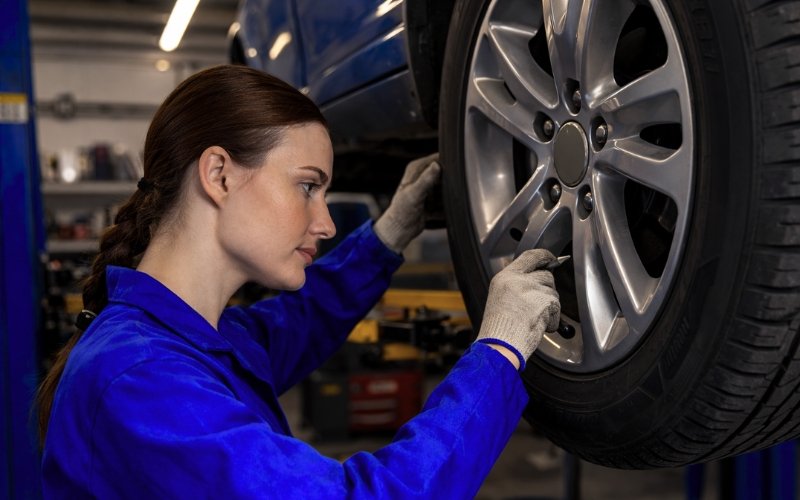

Have you ever walked to your BMW and noticed that the rear tires look worn out? The rear tires always give out first, even when the same roads and driving habits are used. You are not alone if this sounds familiar.
Most BMW owners are unaware of this. It is rare that rear tire wear is due to bad tires or bad fortune. BMW rear wheel alignment is often the culprit, even before you feel anything wrong or your wallet starts to hurt.
Why Rear Tire Wear Is Often Misdiagnosed on BMWs
BMW rear tire wear is often hidden. Even though the car feels stable, the steering is sharp and no warning lights are displayed, it’s clear that something is wrong with its rear tires. Usually, this is where the confusion starts because there’s nothing wrong.
Balance is blamed first before alignment
It seems like the obvious solution to balance. Balancing is quick, easy, and frequently suggested as the first solution. Balance only reduces vibration. The rear axle geometry may be shifting, causing the tires to wear unevenly. Tires are often replaced twice before the difference is realized.
Tire quality is a matter of heat
The tire brand can be blamed for the problem. The tire brand is blamed for soft compounds or sports tread patterns, even if the wear pattern indicates otherwise. The tire will often only respond to the actions of the rear wheels.
Frontal alignment grabs attention
Alignment checks are usually centered on the front wheels, since steering feedback is received from there. The rear wheels can also drift out of specifications, particularly on BMW platforms with rear-wheel drive. The issue is not noticed because the car tracks straight.
In reality, alignment issues with the rear tire are often not apparent until after the second or even third set. The pattern of uneven tire wear will be evident by then. Usually, the fix is simple. Unfortunately, you’ve already paid for the extra costs.
BMW rear wheel alignment is more important than most people think
Car Wheel Alignment Dubai has great handling but is also very sensitive. Even small changes in the rear alignment angle can have a significant impact over many thousands of kilometers. We often notice this long before the owner expects it.
Rear axle geometry controls tire contact:
The rear wheels don’t just roll. The angle at which the rubber meets the road is determined by these angles. Tires begin to scrub rather than glide when the geometry changes, even slightly. Over time, the quiet friction becomes uneven wear.
Camber and rear toe work together.
Camber determines how rear tires lean when loaded. Wear patterns form when either tire drifts. They are most common along the inside edge. This combination is seen on BMWs which are still stable.
Alignment readings may be misleading.
On a computer screen, the alignment values might look good. Under heat, acceleration and long highway drives, the same angles will behave differently. What looks good statically in Dubai can quickly turn into a tire problem dynamically.
The rear suspension components determine whether alignment is maintained.
The condition of the rear suspension components will determine the alignment setting. These angles are held in place by bushings, arms, and mounts. Even after an adjustment, alignments can shift back out if they begin to wear or soften.
BMWs are very good at hiding these changes. Comfort is maintained. Road noise stays low. Tire life continues to decrease, often without warning. Even if there is no obvious problem, it’s important to check the rear wheel alignment.
The three main causes of rear tire wear linked to BMW rear wheel alignment
Rarely is there a single reason for rear tire wear. It usually occurs slowly on BMW vehicles. The interaction between the suspension and alignment angles over time is what shapes it. When rear tire wear is persistent, we see these three problems most often.
Rear Toe Angles Drifting Out of Range
The rear toe doesn’t fail overnight. The tire wear is gradual, and it happens millimeter-by-millimeter. It usually takes a long time for tire wear to become visible.
Why rear toe is so important
Toe determines whether the rear wheels move straight, slightly inward or outward. Even minor toe mistakes cause constant scrubbing of the road surface. We often notice this long before a driver feels any unusual sensation.
How does wear develop?
Surface temperatures increase as the tire wears. Even with normal driving, the outer or inner tread starts to disappear faster than expected.
Why it returns so often
If suspension joints or bushings are loose, the toe setting will not hold. After adjustment, the angles drift out again after driving the car.
Ignoring rear-toe problems is like dragging tires sideways for several months. It may not be obvious at first but the wear will eventually become evident.
Rear Camber Imbalance from Suspension Wear
Camber problems are quiet. Camber problems are usually quiet.
What is camber and how does it affect rear tires?
- Negative camber that is excessive will cause the tire to lean inward.
- The tread is only used to carry a small portion of the vehicle’s weight, the rest being left unused.
What accelerates camber problems?
- Aging suspension bushings that soften over time and suspension modifications that alter factory geometry.
- The heat and uneven road surfaces that you encounter every day, in particular.
Camber damage gets worse
- Camber angles are not settling in balance as rubber components continue softening. Instead, they drift further from the center.
- We often notice this on BMWs, even though they still feel stable.
Owners are often surprised at how much camber can change over time, particularly when there aren’t any obvious warning signs.
Worn Rear Lower Control Arms and Mounting Points
Alignment becomes more of a hardware problem than an adjustment problem. Fine tuning cannot compensate for components which no longer hold the geometry in place.
What are control arms?
The lower rear control arms are used to lock the geometry of the rear axle. They maintain alignment angles under acceleration, braking and load.
Why alignment fails
Even if the technician sets perfect angles, once the vehicle moves, worn-out arms can cause these angles to shift. The alignment appears to be correct for a short time, but then shifts back.
Common signs seen during inspection
- Uneven bushing wear allowing movement.
- A slight rear instability is observed during acceleration.
- Alignment values which refuse to settle in a consistent manner.
It’s like fixing a leak in the pipe without tightening it. The problem persists, even though the symptom is temporarily improved.
How to check the alignment of BMW rear wheels
Each BMW with rear tire tread wear has a different story. It is for this reason that rear wheel alignment should never be treated as a simple checkbox. BMW Garage Dubai is concerned with understanding the reasons why the wheel alignment has shifted.
| What We Focus on | It is handled in a number of ways | Why it Matters to BMW Owners |
| Inspection before adjustment | Check the rear suspension components first | Early checks can prevent tire wear by preventing repeated tire wear. |
| Explaining rear alignment angles | The rear toe and camber measurements are explained in plain English | Owners can now understand the changes instead of guessing numbers |
| Consideration of real driving conditions | The factors of heat, speed, weight, and road usage are taken into consideration | The road behavior is often different from the static readings of machines |
| Only after confirmation can you make adjustments | Once issues have been ruled out, alignment is performed | Avoids fixes that fade quickly |
| Only address parts as necessary | Components will only be suggested if they have an impact on stability | Tires are protected by preventing unnecessary work. |
| Check for stability and not just numbers | The focus is on the alignment of the spheres over time | Results that last, not just those that look good on screen |
This method of BMW rear wheel aligning ensures that tires last longer and the handling is predictable. Owners also avoid experiencing the same frustration over and over again. Focus is on finding the root cause and not just resetting the numbers.
Check Your Tires Before Replacing Them Again
BMW rear tire wear is not random. It usually starts when the rear wheel alignment is out of place, and then slowly leads to tire replacements. Tires that wear out quickly are often the result of a rear wheel alignment that is not done properly.