

This is not a later issue in Dubai driving. This is not one of the issues to delay. The systems are subjected to heat stress and nonstop traffic braking cycles in Dubai-style driving conditions that are punishing the systems on a daily basis. Risk may increase rapidly when the stopping distance is extended, or when emergency braking is unreliable. Most drivers do not pay attention when the traffic will behave abnormally until the brakes fade and overheating silently diminish the control ability especially after several stops. Other people only find out about trouble during the procedure when it comes to the renewal or resale checks, as the process gets halted with the sudden failure by the RTA inspection.
He or she s in the middle of the safety zone and the warning signs can be completely hidden at the beginning. That is why it is important to make a timely brake safety check before the damages multiply, the cost increase, and the confidence behind the wheel decline. The following seven red flags cut through the noise and demonstrate when it is time to take action in regards to Car Brake Inspection in Dubai.
The reasons why these warning signs cannot be disregarded.
Difficulties with brakes do not manifest themselves immediately. They build up silently, one layer after another, until a performance will fail at the moment when it is most needed. The danger of this is that several symptoms that are common in the initial stages become so normal, there is some minor sound, a slight vibration, a change that will vanish following a brief drive. It is the illusion of normalcy that procrastinates.
The UAE has driving conditions that hastens wear patterns in a manner that most drivers do not take seriously. Overheating, frequent stalling and go-stop motion condense years of use to months. When an issue starts to seem like it is clearly evident, it is not uncommon to have secondary damage, which makes repairs more than mere adjustments.
It is because it is more important to identify patterns than to identify one symptom. The red flags below are not accidental irritating gadgets, but related signals which indicate certain mechanical pressure. Early knowledge helps to put the control back into the hands of the driver since one can make well-informed decisions before safety, time or budget are jeopardized.
Sign 1| Squealing, Grinding or Metal-On-Metal Noises.
The screaming of high tones or hard grinding sounds will never be considered background noise. They are audible warnings incorporated in the Car Brakes to remind of wear effects before safety falls. A squeal indicator in most occasions is already rubbing on the disc, which is indicative of pad-material being almost worn off. Shake it and the sound varies rapidly, the metal plates supporting it begin to cut through the disc surface.
It is there that damaged brake pads and rotor damage start to go.
This is followed by deep rotor grooves, observable scoring and excess brake dust, which transforms a minor pad replacement to a bigger repair job. The outcome is an augmentation of NVH (noise/vibration/harshness) and deterioration of stopping control. The further driving at this point only accelerates the wear of brake pads and rotor corrosion hence the next move would always have to be a professional test on the pad thickness, disc and appropriate replacement time before the expenses blow out of proportion.
Sign 2| Vibration through Pedal or Steering Under Braking.
The vibration that is experienced on the pedal or steering wheel is not random feedback of the road. It is normally a quantifiable mechanical problem that occurs within Car Brakes. The cause of the pulsing feeling can be warped rotors, uneven transfer of the pads, or excessive rotor run out all of which will increase in strength as the condition remains neglected. The problem is not improved by the heat cycles.
Unchecked this vibration usually is directed to the development of Worn brake pad and rotor damage, in which contact surfaces are no longer interacting evenly. Other drivers will think it is a case of alignment or suspension, a quick check of the wheel bearing will normally isolate the exact problem in a few hours controlled road-test. Delaying vibration will grow stronger, adding to the distance taken to halt and pushing the costs of repair upwards. Early inspection makes the fix easy, manageable and predictable, by the time the braking comfort and confidence suffer further.
Sign 3| Burning Smell, Smoke, Or Braking Weakness after Repeated Stops.
The indication of a burning odor or light smoke following heavy-use is very serious, particularly during high-temperature driving. Car Brakes repeated stops may result in heat-soaked rotors and pads being unable to produce friction. This causes the Brake to fade and overheat directly as the stopping power reduces yet the pedal still seems normal.
Once the temperatures rise, the drop in the friction coefficient can be felt, the braking force is augmented but without success. This stress is increased by downhill braking and stop-stop driving. Driving in this condition increases the rates of Brake fade and overheating and increases the safety risk in a short time. The right action is to relax, leaving components to cool down, and arrange an examination at once. By ignoring these warnings, one does not burn the issue away, they only make the system less safe by reducing the time frame in which it can operate.
Sign 4| Pedal Soft, Travels excessively, or Braking feels unreliable.
In cases where the foot-pedal is tender, or sinks all the way in instead of half its usual distance, the trouble is never in mechanical friction, but in hydraulic. The most common cause of a Spongy brake pedal refers to the presence of fluid contaminated with moisture, air in lines or fluid that has overheated and passed its safe boiling point. Under such circumstances, there is no clean transfer of pressure such that response is inconsistent at moderately high speeds.
Car Brakes are based on closed hydraulic pressure in order to be predictable. When such a seal is broken, things start to get out of control. Here a Brake fluid flush will be of paramount importance, as the correct pressure and heat resistance are restored before some serious faults will manifest. Professional check normally involves a pressure test and quick inspection of master cylinder fundamentals to eliminate internal bypassing. Leaving a Spongy brake pedal unattended will only encourage the issue to increase, and what could have been a fairly straightforward service will become a significantly more complicated fix.
Sign 5| Brake Warning Light, Low Fluid, Or Sudden Change after Service.
The warning light about the brakes, or a sudden reduction in the fluid level should not be brushed off regardless of whether it shows up soon after the service. These are usually indications of leaks or loss of pressure in the Car Brakes and not electric glitches. Leakage of fluids can be indicated as a caliper leakage or poor hose structure and both will limit the effect of braking soon.
When the pedal is experiencing some changes at night, there is a possibility that a Spongy brake pedal is already developing either because of air intake or leaking fluid. Brake fluid flush In other instances, repairs necessitate a Brake fluid flush to reinstate an appropriate balance of pressure. An ABS system check and an excellent post-service check can be used to ensure that everything is closed and that it is operating properly. Running on red lights not only postpones the detection of a problem, it also raises the risk level and transforms a minor hydraulic problem into a safety emergency.
Sign 6| Brakes Fine – Then Slows Down in Heat or Traffic Jams.
All may seem normal initially, but then the sudden stop after long driving. The trend is also prevalent when Car Brakes are subjected to extensive driving cycles in congestion and heat. Surfaces of friction become hot and form hot spots as well as create glazing that diminishes bite without clear indication.
This is a typical symptom of Brake fade and excessive heat and is usually accompanied by the premature Worn brake pads and rotor wear due to the use of an inappropriate pad compound in the local environment. This is hastened by poor ventilation particularly when there are slow downs that are repeated. Due to the slight recovery of the system after getting cool, most drivers postpone. The delay enables the surface damage to grow and a problem that is related to heat becomes a complete component replacement. The issue is fastened down by early inspection when braking reliability is still declining.
Sign 7| Failing Check or Flagged Before Renewal or Transfer.
Nothing disrupts plans more than a sudden failure of an inspection of RTA during a renewal or transfer of ownership. Mostly, it is not an overnight problem, but old-fashioned wear that is finally accounted for. Minimal thickness, surface condition and imbalance in brake efficacy across axles are inspected. Readings that are not within bounds lead to automatic rejection.
Car Brakes fail such tests because of the old Worn brake pads and rotors damages that had not been detected during day to day driving. Uneven wear and heat marks are hard to notice without a lift and appropriate equipment. A pre-check is an examination of commonly significant inspection points, balance checking stops and worn brake pads and rotor damage. This strategy will not cause haste repairs, delay re-tests and save time where deadlines are of utmost importance.
Proper Brake Safety Check.
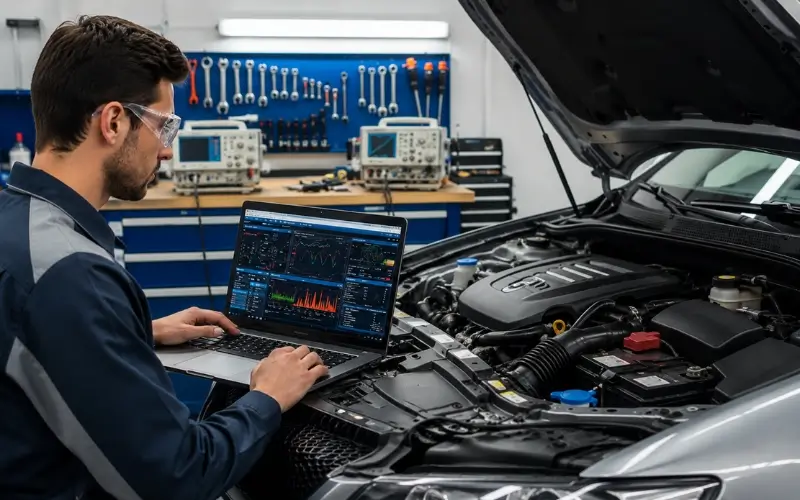
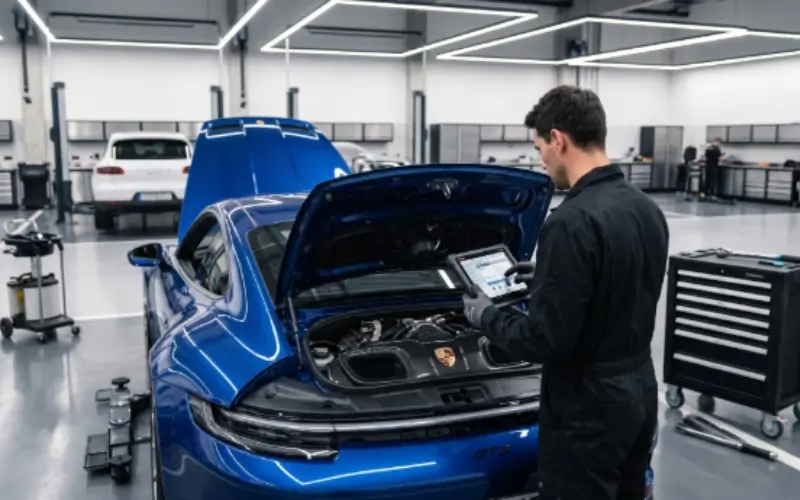
Professional brake checking is not a chance or a peep through the wheel. It is an organized routine that is meant to ensure the safety, checks on the level of wear and elimination of any hidden dangers before they become serious. By evaluating the Car Brakes properly it will also remove the unnecessary replacement and foster confidence in the test results.
This would also point out early heat related problems that can cause Brake fade and overheating many years before braking performance declines on the road. Each of these is recorded in writing, each step is described clearly and backed up by actual measurements, not guesses. A thorough brake inspection would normally consist of:
- Pad thickness to ascertain remaining service life.
- Rotor thickness and runout checks used in order to identify warping or surface anomalies.
- Checking of caliper slide pins in order to move smoothly and evenly.
- Brake fluid tester test to determine the moisture content and boiling point.
- ABS scan to eliminate stored fault codes.
- Dynamic road experiment to confirm braking when loaded.
- Written estimate with findings, priorities and options.
Such openness of processes eliminates overselling and makes sure that decisions in repair are not taken under pressure but are evidence-based.
Parts Choices, Turnaround, and What Really Is Replaced.
This step defines a brake repair as a long-lasting or a recurring issue. The selection of parts is clear, realistic turnaround time, and replacement decisions are documented to ensure the preservation of the long-term value and the safety of the end-users.
It is Important to Select the Right Parts More Than the Price.
Not every replacement has the same result. In the case of servicing Car Brakes, OEM and Original parts have impacts on the longevity and safety. OEMs produce the original parts in higher specifications, and even OEM-branded parts sold independently are of inferior quality. This difference is of utmost importance in the cases of Worn brake pads and rotor damage, where the grade of material and heat tolerance affect the outcome directly.
Proof, Post- Repair Confidence, and Turnaround.
Before a job is approved, it should have proper timelines, a documented reading as well as clear photos or readings of the repair. Controlled bedding-in guidance provides uniform friction and wear uniformly after installation. Thus expectations of performance are established at the beginning of the process, no false alarms, no empty promises.
Read Also: Book Car Dubai
Schedule a Brake Test Before It Becomes a Larger Job.
Minor warning signs hardly remain small. By fixing the brakes at the initial stage, the process remains easier, safer, and much more economically controlled. The same day inspection provides you with a clear report that offers options rather than pressure making all the decisions informed and practical.
My Car Repair Dubai is the best place to get professional and transparent, careful and experience brake service to the drivers in Dubai. The booking process is not complicated (call, message, or form) and the team clarifies the following operations before the work is done. Timely delivery ensures safety, avoids frequent visits, and an inability to solve minor problems before turning them into significant downtime.